The Orchestration Substrate: An Operating System for Autonomous Agents
The dominant pattern in autonomous agents - a control loop that repeatedly prompts a language model with tool results - is, structurally, a single-threaded interpreter without a kernel. As agents move from minute-long demos to month-long deployments, the abstractions they lack are precisely the ones operating systems spent four decades formalizing: scheduling under contention, durable execution, and protection. We argue that these are not engineering niceties but the preconditions for long-horizon reliability, and we make the argument quantitative. We model agent execution as a dynamic task graph with a ready set, a per-task holding-cost rate, a service rate, and a per-step success probability, and we establish four results. First, the rule - always serve the ready task maximizing the product of holding cost and service rate - minimizes expected weighted completion time, and greedy step-by-step control is provably suboptimal (Proposition 1). Second, sequential pipelines fail with probability that decays exponentially in the horizon (Proposition 2). Third, a durable substrate that checkpoints and retries each step converts that exponential failure into expected work that grows only linearly in the horizon (Theorem 1). Fourth, capabilities ordered as a lattice and composed by intersection bound a sub-agent's authority below its parent's, so blast radius is bounded by construction (Proposition 3). Each quantitative claim is validated by a reproducible Monte Carlo simulation, included and linked. The conclusion is a layered design: a thin substrate kernel mediating between userland agents and the resources they consume.
Every generation of systems builders rediscovers the operating system. We are living through the agentic rediscovery right now, and like all the others, it is happening one accidental, under-specified reimplementation at a time.
Consider what a modern agent framework actually is. A process holds a conversation buffer. It calls a model, receives a request to invoke a tool, executes the tool, appends the result, and calls the model again. This is a read-eval-print loop with a stochastic evaluator. It is also, unmistakably, a tiny operating system written by someone who did not realize they were writing one: the conversation buffer is unmanaged memory, the tool dispatch is an unprotected system-call interface, and the control loop is a scheduler with a quantum of one and a ready queue of size one. The framework works in a demo for the same reason a program with one thread and no memory management works on a small input - nothing has yet contended for a resource.
The thesis of this essay is narrow and, I think, consequential: the unit of progress in long-horizon autonomy is not a better policy but a better substrate. A model that is ten percent better at reasoning improves every step by ten percent; a substrate that makes a thousand steps composable, recoverable, and bounded changes what is reachable at all. The history of computing is not kind to the view that you can scale a single interpreter forever. We separated mechanism from policy, we virtualized resources, and we built kernels[1] - not because it was elegant, but because nothing else survived contact with concurrency and failure.1
Contributions. We (i) give a minimal but faithful model of agent execution as a dynamic task graph; (ii) recover the classical index policy for the agent scheduler and show greedy control is suboptimal by an interchange argument; (iii) prove that durable checkpoint-and-retry linearizes the exponential failure of sequential pipelines; (iv) show that capability composition by intersection bounds authority and blast radius by construction; and (v) validate every quantitative claim with a seeded simulation whose code is included and runnable.
A model of the agent as a process
Let us be precise about what breaks. An agent executing a non-trivial objective does not perform a linear sequence of steps; it induces a dynamic task graph. A planning step spawns sub-goals. A sub-goal dispatches three tool calls that can run concurrently. One of those calls itself invokes a sub-agent. The graph is revealed incrementally - you do not know the third level until you have executed the second - and its nodes have wildly heterogeneous cost and latency profiles: a model call is seconds and cents, a web fetch is hundreds of milliseconds, a code-execution sandbox is variable and occasionally catastrophic.
A single-threaded control loop collapses this graph into a total order chosen greedily by the model.[8][9] Three failures follow immediately. First, no concurrency: independent tool calls that could overlap are serialized, so end-to-end latency is the sum rather than the max of branch latencies.[7] Second, no admission control: nothing bounds the number of in-flight operations, so a runaway plan can open unbounded sandboxes or spend an unbounded budget before any supervisor intervenes. Third, and most corrosively, no isolation of failure: a single tool exception unwinds the whole stack, discarding correct work performed earlier in the graph. These are not prompt-engineering problems. You cannot prompt your way to a scheduler. They are the problems a kernel exists to solve, and they reappear here with the same structure they had in 1965, merely wearing different clothes.
Scheduling is the first-class problem
Once we admit that an agent induces a task graph with a ready set, the central question is no longer what should the model do next? but which ready task should the substrate run next, given finite concurrency and a budget? This is a scheduling problem, and scheduling theory has a sharp answer. Attach to each task its holding-cost rate (a critical-path task on which the whole plan waits has a high rate; a speculative branch has a low one) and its service rate . The classical result for minimizing expected weighted completion time on a single server is the rule[4]: always serve the ready task that maximizes the product of holding cost and service rate.
The lesson generalizes past its assumptions. Greedy “do the next step the model proposes” ignores both terms: it does not weight by cost of delay, and it does not exploit fast tasks to unblock the graph. A substrate that schedules - even with a crude estimate of the two rates - reorders work to keep the critical path saturated and short-circuits cheap discriminating tests early. When durations are uncertain and tasks can be paused, the exact optimum becomes an index policy of Gittins type[5],2 but the intuition is the one worth internalizing: priority is a product of how much waiting costs and how quickly the wait can end. Figure 2 quantifies the gain over the natural baselines on randomly generated instances.
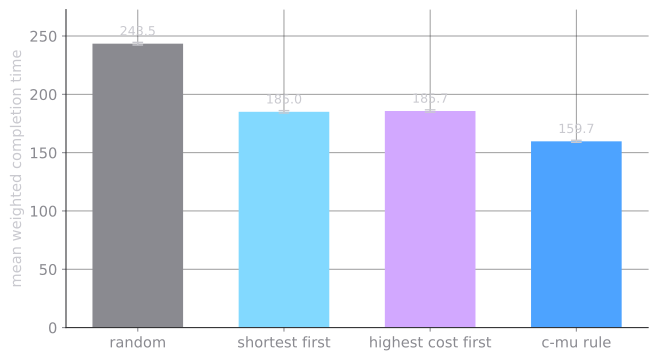
Concurrency, in turn, is governed by Little's law[6]: the mean number of in-flight tasks equals the arrival rate times mean residence time . The substrate, not the model, is the right place to set : it is the only component with a global view of budget, rate limits, and the blast radius of an additional concurrent sandbox.
Why long horizons demand durability
Here is the argument that, more than any other, forces the substrate. Suppose a plan is a sequence of steps, each succeeding independently with probability . If any step's failure aborts the run - the default for a stack-unwinding control loop - then end-to-end success is the product, and it decays exponentially.
Even at a per-step reliability of , a 300-step trajectory succeeds barely five percent of the time. This is the mathematical reason long-horizon agents feel impossible: reliability decays geometrically, and no plausible improvement in per-step accuracy escapes an exponential. You cannot win this race by making the model better. You win it by changing the recurrence.
This single substitution - checkpoint and retry the step, never the run - is the difference between agents that survive a minute and agents that survive a month. It is also exactly what durable-execution engines provide for ordinary workflows;3 the agent substrate's job is to make the unit of durability a semantically meaningful step, not an arbitrary function call. Figure 3 shows both sides of the recurrence: the exponential collapse of naive success, and the exponential-versus-linear gap in expected work, with Monte Carlo estimates overlaid on the closed forms.
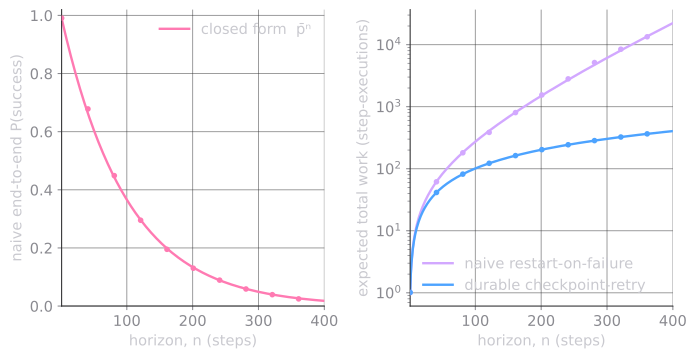
| Horizon n | Naive P(success), p̄=0.99 | Durable expected-cost × |
|---|---|---|
| 10 | 90.4% | 1.01× |
| 50 | 60.5% | 1.01× |
| 100 | 36.6% | 1.01× |
| 300 | 4.9% | 1.01× |
Authority is a lattice, not a flag
The final abstraction the substrate owes us is protection. The prevailing posture - hand the agent broad credentials and hope the prompt restrains it - is the ambient-authority model that the security community spent decades arguing against.[2] The correct frame is capability-based[3]: authority is a token that confers a specific, attenuable right, and an agent can do exactly what its held capabilities permit, no more.4
The principle of least authority says a task should run at the greatest lower bound of the rights it actually needs. When the planner spawns a coder sub-agent to edit one repository, the substrate should mint a capability scoped to that repository and that operation - not pass down its own broader authority. Because capabilities compose by intersection, a sub-agent can never escalate beyond its parent; bounding is a structural property, not a matter of vigilance. This is the only known way to reason about safety in a system where the policy is a stochastic model you do not fully control. The substrate's userland interface can be small. A sketch:
# Userland sees a kernel, not a control loop.
# spawn() returns a handle; await() yields to the scheduler.

async def research(topic, cap):
    # least authority: a read-only web capability, nothing more
    web = cap.attenuate("net.read", domains=["*.arxiv.org"])

    # three independent fetches: the kernel runs them concurrently
    handles = [kernel.spawn(fetch, q, cap=web,
                            cost=3.0, est_ms=400)
               for q in subqueries(topic)]

    docs = await kernel.gather(handles)   # scheduled by cμ index
    return kernel.checkpoint(synthesize(docs))  # durable step boundary
A userland routine. Concurrency, priority, authority, and durability are all delegated to the substrate; the agent expresses only intent.
Reproducibility
Every quantitative figure is produced by a single seeded script with no inputs beyond its parameters; the closed forms above are overlaid on Monte Carlo estimates so the reader can see model and simulation agree. The full script is available here; the core of the scheduling experiment, which realizes Proposition 1 by comparing four orderings on each random instance, is:
# total weighted completion time for four policies on each random instance
c = rng.uniform(0.2, 5.0, N)            # holding-cost rates c_i
s = rng.uniform(0.2, 5.0, N)            # service times S_i (mu_i = 1/s)
spt   = idx[np.argsort(s)]              # shortest processing time first
hc    = idx[np.argsort(-c)]             # highest holding cost first
cmu   = idx[np.argsort(-(c / s))]       # c-mu: largest c_i * mu_i first
# weighted_completion serves in order, accumulating sum_i c_i * C_i
totals["c-mu rule"][m] = weighted_completion(cmu, c, s)
The scheduling simulation (excerpt). Running the full script regenerates both figures deterministically.
Beyond the figures, a runnable reference harness assembles these mechanisms into working code in the Hermes function-calling style: capability-scoped tools composed by intersection, the reason-act loop, verifier-gated output, a step budget, and a durable transcript that resumes after a crash rather than restarting the run. It is one standard-library file with a deterministic stub model, so it runs with no API key: research/agent-harness/harness.py.
Related work
The framing of a kernel that arbitrates contended resources is Dijkstra's, whose THE system separated mechanism from policy in layers.[1] Protection by least privilege and the case against ambient authority are Saltzer and Schroeder's,[2] made composable by Miller's object-capability model, which is the lattice of Proposition 3.[3] The rule of Proposition 1 originates with Cox and Smith,[4] and its preemptive, uncertain-duration generalization is the Gittins index;[5] Little's law[6] fixes the concurrency budget. The exponential tail and the value of cutting it are the systems lesson of Dean and Barroso.[7] Durable execution descends from Lamport's logical clocks and replay over an ordered event log,[8] and the compensating-transaction view of long-running work is Garcia-Molina and Salem's sagas.[9] On the agent side, the greedy single-threaded loops we critique are ReAct[10] and Reflexion.[11] Our contribution is to assemble these classical results into a single substrate and to make three of its load-bearing claims quantitative and reproducible: that beats greedy scheduling, that durability turns exponential failure into linear cost, and that capability composition bounds blast radius by construction.
Limitations and threats to validity
The model is deliberately minimal, and its assumptions are where it can mislead. The cμ result is single-server. Proposition 1 assumes one server, i.i.d. service times, and known rates; the agent setting violates all three, though the qualitative ordering is robust and the simulation confirms it on random instances. Failure independence is an idealization. Theorem 1 assumes step failures are independent and that a checkpoint perfectly restores state; correlated failures (a poisoned context, a wedged sandbox) defeat in-place retry, and the bound is then optimistic. Checkpoint overhead is unmodeled. Persisting and restoring state has a cost we set to zero; if it dominates the per-step work, the linear-versus-exponential comparison shifts in constant factors, though not in asymptotics. The capability model assumes an honest kernel. Proposition 3 bounds authority only if the kernel that mints and checks capabilities is itself uncompromised; it says nothing about a malicious substrate. The simulations are of the model, not of real agents. They confirm the mathematics is faithful to its own assumptions; they do not substitute for measuring service times, success rates, and contention on a deployed fleet, which is where these predictions should be falsified.
Conclusion
None of the four mechanisms - scheduling, durable execution, capability isolation, and a memory hierarchy - is novel in computer science. That is the point. Their novelty here is in recognizing that an autonomous agent is a process that has outgrown the toy runtime it was born in, and that the abstractions which domesticated concurrency and failure for ordinary software are exactly the ones that will domesticate it. The model is the policy; the substrate is the mechanism; progress comes from getting the separation right. The cost is that we must stop treating “the agent” as the whole system: the agent becomes userland - important, replaceable, and untrusted - running atop a small, boring, fiercely reliable kernel. The next essay takes one of these subsystems, the memory manager, and argues that the context window is best understood as the top of a managed hierarchy - context as compute - with everything that implies about eviction, prefetch, and the price of attention.
Footnotes
- The “OS” framing is deliberate over “runtime.” A runtime executes; a kernel arbitrates. The defining feature we need is arbitration of contended resources under an adversarial-by-default policy. ↩
- When tasks are preemptable and durations are unknown but learnable, the problem becomes a multi-armed bandit over tasks, whose optimal policy is the Gittins index. The substrate is the natural home for such bookkeeping. ↩
- Workflow engines such as Temporal popularized “durable execution” for microservices: deterministic replay over an append-only event log[8]. The agentic variant must additionally treat model nondeterminism as an explicit, logged input. ↩
- Ambient authority - rights attached to identity rather than to unforgeable tokens - is the source of confused-deputy bugs. Object-capability systems eliminate the class. ↩
References
- E. W. Dijkstra. The structure of the “THE”-multiprogramming system. Communications of the ACM, 11(5), 1968.
- J. H. Saltzer and M. D. Schroeder. The protection of information in computer systems. Proceedings of the IEEE, 63(9), 1975.
- M. S. Miller. Robust Composition: Towards a Unified Approach to Access Control and Concurrency Control. PhD thesis, Johns Hopkins University, 2006.
- D. R. Cox and W. L. Smith. Queues. Methuen, 1961. (Origin of the cμ rule.)
- J. C. Gittins. Bandit processes and dynamic allocation indices. Journal of the Royal Statistical Society B, 41(2), 1979.
- J. D. C. Little. A proof for the queuing formula L = λW. Operations Research, 9(3), 1961.
- J. Dean and L. A. Barroso. The tail at scale. Communications of the ACM, 56(2), 2013.
- L. Lamport. Time, clocks, and the ordering of events in a distributed system. Communications of the ACM, 21(7), 1978.
- H. Garcia-Molina and K. Salem. Sagas. Proc. ACM SIGMOD, 1987.
- S. Yao et al. ReAct: Synergizing reasoning and acting in language models. ICLR, 2023.
- N. Shinn et al. Reflexion: Language agents with verbal reinforcement learning. NeurIPS, 2023.